Powered By Blogger

Sunday, October 21, 2012

The Validity of Female Related Game Design and the Altercation of "Girl games"

Game design has grown beyond the arcade room based shooters.Games are constantly adopting characteristics that attract female players. The ever recent convergence of the female into what is known as a male avocation may give better awareness into the architecture of educational atmospheres that adhere to gender inclusive appraisals in the composition.

There are various explanations as to why digital games have arisen as a "guy thing." However, the increased amount of female games that are designed for girls may condone women to see technology such as computers as good instruments. The question is to how valid this argument really is.

As Michele D. Dickey notes,

" The main problem with developing games specifically targeted for girls and women is the question of whose notion of female is being portrayed in the game. There is danger in perpetuating cultural values that limit female roles and participation." Michele D. Dickey, Girl Gamers: The controversy of girl games and the relevance of female-oriented game design for instructional design.

Hence, it is significant to cross-examine whether the benefits of female apertures will defeat the conceivable disadvantage. Games such as Disney and Barbie definitely feed into specific stereotypical female interests.

"Interestingly there are many commonalities between elements of female-oriented game design and the types of tools and opportunities in constructivist learning environments. Many games are increasingly constructed as representations of 3D spaces, allowing players to move and interact in stimulated realistic or fantasy environments." (Dickey)

With that being said, for the composition of learning atmospheres, it is very important for apprentices to seek contingencies for investigation and direction to advance their building of understanding. Various games are also developing socialized atmospheres where global players may consort to one another and create gaming strategies. These days characteristics of female-oriented design are indeed integrated in contemporary massive multiplayer online (MMO) role-playing games such as World of Warcraft. Not to mention, women are commonly known to be drawn to different aspects of this type of gaming than men are.

"In massive multiplayer online games, men are significantly more likely to play games due to the possibility of great achievement and the ability to manipulate the game environment for personal gain, where women are significantly more likely to play games due to their desire to interact with fellow gamers and form meaningful relationships." Nicholas Maisonave, Gender in Gamer Culture and the Virtual World.

Much is to be learned regarding what exactly draws both males and females into specific aspects of game design. Taking a look at how females converge into what was once known solely as a male pastime gives insight, methods, and strategies in educating game designers how to communicate experiences and atmopheres to students of both genders.


Sunday, October 14, 2012

Fight Like A Girl--Female Opportunity arises in social online atmospheres.

The relationship between gender and gaming is intricate and functions in a variety of layers. It is significant to see gendered gaming beyond its text.We must also take a earnest course to the female gender's influence. Within distinguished and constant ideas, femininity and masculinity are not themselves.Hence, communication and interplay between the two conveys a meaning. It is clearly obvious that gaming customs are experiencing an increase in fast communal and mechanical adjustments.

Jo Bryce and Jason Rutter's Killing Like a Girl: Gendered Gaming and Girls' Visibility indicates differences in the females' construction of a text's meaning through computer gaming. The banal representations of women game characters takes an apathetic stance of constructed meanings in conjunction to feminine and masculine representations within games.

"It is possible that females construct different meanings in relation to the themes of computer games, may play games in a masculine fashion, and/or may construct their own oppositional meaning of game texts." -Bryce and Rutter


As for real world aspects, most gaming has frequently been connected to the mannerisms of "bedroom culture." This relates to a stereotype that females do not play in the same atmosphere that males do.

"Originally conceived as female use of domestic space, bedroom culture highlights the manner in which girls are restricted from full access to many social spaces and are instead left on the periphery of public social spaces (such as playgrounds)"-Bryce and Rutter

Developing proof shows that many females actually prefer taking part in gaming within homely conditions such as with their partners, family, and friends. One may note the significance of social leisures for women who play. Massive multiplayer online (MMO) games may have an effect on the overall female participation in games. Not to mention, a majority of the increased amount of online players are infact girls.

"It has been suggested that females are more affilitative and nurturing, preferring leisure activities which have a stronger social aspect."- Bryce and Rutter

Females may feel free of gender discrimination online as their physical attributes are anonymous. This perhaps deducts the banal behaviors that may attack female gamers. Opportunity arises for females if their identity is masked by the anonymity of online gaming. Hence, women are benefit in competing against guys without being discriminated against.

"Because 'girl gamers,' gorgeous or not, are still considered rare, regardless of consistent evidence to the contrary, women gamers gain a fair amount of recognition and attention through the social power of gender." Elizabeth McMenomy, Game On Girl: Identification and Representation in Digital RPG's

All in all, women who play games hold an important place in the ever developing culture of games all around the world. Girls that game are a very large and growing force in gaming culture which challenges the overall stereotypes associated with video games.

Monday, October 8, 2012

Video Game magazines also hint discrimination of women in games.

Monica Miller's 2008 article Gender Differences in Video Game Characters’Roles, Appearances, and Attire as Portrayed in Video Game Magazines analyzes video game magazine articles while investigating how characters are portrayed, with the focus on the difference in the sexes. The text's content analysis aspires to test messages portrayed in video games by examining the composition of video game articles from the three primary gaming console magazines in the United States—Playstation Magazine, Xbox Magazine, and Nintendo Power (which is soon to go out of print in December 2012).

After investigating these magazines, Miller found that male characters are made to be protagonist or hero, be more muscular, have more skills, hold more weapons, and have an overall dominant power. Females are frequently portrayed as auxiliaries.They are also more sexually attractive as they wear more revealing clothing. Comprehending the messages within these games is a significant path to understanding the effects games and magazines may have on our overall manners and dispositions as male and female.


photo by: joystiq

The article goes onto describe how mass media is capable of influencing many behavioral social standards that involve body image, sexual behaviors, self esteem, and gender identity.

"Studying video game magazine articles is important because this is a separate media than the games themselves. Knowing what kinds of images video games articles portray is important,just as it is important to study other types of magazines, movies, songs, and other media." (Miller)

Content analyses of video games and video game advertisements have consistently found that women are underrepresented, more frequently sexualized, more attractive, less powerful,and dressed more scantily than males.

As Karen Dill's Video Game Characters and the Socialization of Gender Roles: Young People's Perceptions Mirror Sexist Media Depictions notes, one may find  that women are scarcely represented in video game magazine articles and advertisements, with less than a quarter of featured photos of video game characters in these magazines being female.

"Consistent with past content analyses of video games that found most popular games to be aggressive, we found that the great majority of video game characters (77%) in game magazines are aggressive." (Dill)

Both articles point out a woman's potential to become socially depressed or obtain lower self-esteem levels if they are exposed to some of the articles and images within the magazines. Researchers observed how media can influence the negative behavior patterns of women.

"Women who are exposed to images of “ideal” (e.g., very thin) women in the media report increased levels of body dissatisfaction, negative mood and depression, and lower levels of self-esteem as compared to women who are not exposed to these images. The influence of the media on young women’s body image have led researchers to speculate that media might also play an important role in negative behaviors such as eating disorders." (Miller)

Miller's findings in video game magazines suggest the development of gender roles and attitudes of the human kind. Note that because of this, females may feel that women are too submissive and need a man to save them. The idea that there are subtle amounts of girl characters in games and even less female protagonists or heroes could also be disheartening to women. Males who see this portrayal of females could possibly develop adverse attitudes toward the female gender. Characters of both genders: female and male could understand the woman character's part as the idea that women are not important and can't be heroes. Hence,

"women will have to idealize male characters or endorse the more stereotypical female portrayals." (Miller)

Even if the majority of both men and women play games, the game companies aim to please an audience that is dominantly male. Thus, game magazines often accentuate the female's violence, sexuality and overall attractiveness.

As Karen Dill notes, "Sexualized and stereotypical sex role portrayals Females were categorized as sexualized/curvaceously thin if the image portrayed was consistent with Harrison’s (2003) curvaceously thin appearance ideal (e.g., large breasts and small waist) and if the figure’s sexuality was stressed such as by showing cleavage, wearing provocative dress, or displaying provocative poses, postures or facial expressions. For example, a female character from Grand Theft Auto: San Andreas licks her lips in a sexualized manner, while bending over, revealing tan lines and a tattoo under her bikini top."

Even throughout magazines, the sexual discrimination of even both genders can be shown. It's important to notice these things as advertisements can be just as effective as actually playing the game itself. From the way images are layed out in the magazines to the amount of content featured with in the articles themselves, all have effects on how we as women and men portray the world and the roles we're "supposed" to live by as genders

"Analyzing magazine articles provides more detail than analyses of either brief game play or advertisements used in past studies and thus allowed for greater exploration into the roles and appearances of characters."(Miller)

Tuesday, September 25, 2012

Sexual Representation and Discrimination of the Female Character in video games

Even though film and television are not perfect in portraying strong gender equality, video games remain the least fruitful for female representation. Although there there are various examples of distinctively strong, and more importantly,realistic female characters in television and film; there are fewer portrayed throughout video games.

Many games these days usually stereotype girls into a category that mainly focuses on the satisfaction of male viewers. In 2004, a female fighting game named Rumble Roses was released. The game featured a over 20 female characters. The women were classified into sexualized versions (complete with matching sexy outfits) of cheerleader, teacher, nurse, and ninja. While initially sounding like costumes from a lingerie catalog, these characters have emotional responses and fruitful backgrounds.

The ladies' strive to fight for their various wants in life such as wanting to sing, win, and wrestle. The accredited female characters challenge women's assumed characteristics by wrestling one another in the dirt. The dominant male view clearly exists as the characters tackle one another and end up in very sexualized, bewildering positions. One may note that similar things happen even when the female character is the protagonist.


photo by: BITTERLY

"The tired gameplay certainly seems a secondary concern to the developers. Sure, there is a mediocre wrestling game in here somewhere, but Rumble Roses‘s main concern is with women, or more specifically, their well-rounded body parts."-Ryan Smith


photo by: Avane

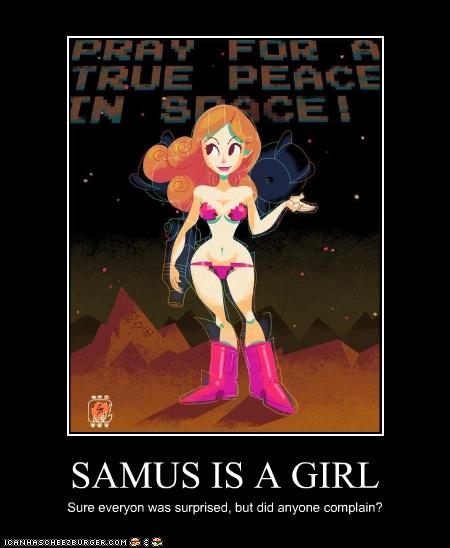
Believe it or not, at one time there were games that took a stab at empowering the female character and gamer. Take NES's original Metroid for example. Even though Samus Aran is discovered as female at the end of the game, her identity is completely hindered during the actual game play. When Samus is revealed as a woman in the end, one might assume that the point is to prove that women are just as strong as women. To contradict that statement, men might also feel that a female hero is weak leading to their disappointment in the game all in all.

"As you play through the game the character gets more powerful and you start feeling pretty badass with this butch, bounty hunter character at your control. The thing is, when you get to the end of the game you get a peak under the suit… and would you know it, Samus is a girl!"- Jim Lockey, The Representation of Women in Video Games


photo by: baroque_vulcan

As Lockey notes, Samus' character was created in the 80's to notion that video games are not sexist. Many gamers will cite the example of Samus as some kind of proof that games aren’t sexist. Arguably, she is a great example of a dominant and strong female character. The fact that she has been hidden by a stereotypical male suit of armor. Then again, an empowerment factor does go into effect by the very simple face that Samus Aran is disguising her femininity. At that time (1980's), Samus Aran's character was definitely a big jump for the future of female representation in video games.

It is very curious as to why there were not any firm female leads to come far after the 1980's. Lara Croft of the Tomb Raider series was the next jump in 1996. Croft has had many edits to her image over her reign in strong female representation.

Unlike Samus, Croft was a lot more feminine as her identity was not hindered for the entire game play. Arguably, her femininity that caters to the dominant male desires in video games. Lockey notes that various models have also been casted as Croft only to sexualize her character that much more.


photo by: newlaunches

During game play, Croft moans in a sexual manner while stepping and climbing bumps and hurdles. A relative depiction of female characters only takes place if it results in fiscal increases given to the publishers. As the newest installation of the Tomb Raider series emerges, one may find that even though Lara has a new look, she is indeed becoming even more sexualized. Also note that there were even films released starring Angelina Jolie, a very attractive and popular actress, especially among male viewers.

"Though female video game characters appear to be underrepresented overall, as active characters, and as playable characters, they are proportionally more likely than males to be portrayed in a sexualized fashion. These results beg the question: If this is the nature of female video game characters, should their number be increased after all?"- James D. Ivory, Still a Man's Game

Friday, September 21, 2012

Body Imagery vs. Realism: Representation of Female Bodies in video games

Even when females are heroes, they are frequently related to remaining auxiliary to the dominant male or hyper-sexualized in terms of their body type, fashion, and manner. Females characters are also created to be less bodily aggressive than male characters They remain contributors as opposed to adversaries.

Women characters are portrayed as nearly naked by wearing very thin or skimpy clothing. Their cleavage does not go unseen because of their ridiculously low necklines and small amounts of clothes. Their waistlines are often so thin that the only part visible is indeed, their breasts. A great example of this can be shown through looking at the characters of the Soul Calibur series. Below is a picture of Ivy Valentine, a female character from the series. Notice how much emphasis exists from the chest down in this image. Her body represents the notion of skimpy clothing and voluptuousness in female video game characters. Her waistline is nearly invisible as her breasts invade the space in this image. It is evident that in real life, these kinds of bodies do not typically exist. Although she may be considered a hero or important character in the game, it is overshadowed by her sexualized body image.


image by: Stregatto10

"To date, there is no published systematic research on female body imagery in video games, but a casual examination of the video game landscape suggests that the female characters featured in many of these games may conform to the skinny-yet-busty ideal featured in other media." -Dmitri Williams

Although they may not intend on doing it, it seems that female character developers believe that it's alright for female characters to be as resistant and active as their male counterpart. Only if she is in some way sexualized, this will hinder her strengths when being compared to male characters.

"For a woman, who may not be voluptuous or want to be objectified by men, there may not be much desire to engage with a media product where this is the common depiction of femininity (Martinson, 2002)."- CarrieLynn Reinhard

photo by: dis-ndat

The picture above represents the female body image that we see in everyday life. It is more common to see bodies like this as opposed to the one featured earlier because they are real. As mentioned before, the bodies portrayed in video games are completely unreal. The fact that men can play as the female protagonist (whether it be Ivy Valentine in Soul Calibur or Lara Croft in Tomb Raider) allows the woman's body to be controlled and therefore gazed upon by the dominant ideology. The video game business fundamentally boosts itself in developing games that male end users will want to engage, and failing to give bigger quantities of games with adverse-depictions for players of both sexes.

"Past research has found a level of ambivalence among women as they deal with themedia's depictions of female beauty, such as the curvaceously thin.Women shown idealized or sexualized body types have indicated more dissatisfaction with their own body, especially if they have internalized the norms portrayed,all the while being critical of sexualized portrayals in general." -Reinhard

Maybe potential female players would refuse to engage in a video game involving such a character because of their lack of enthusiasm to relate to the character. Contrary to this idea, male end users might enjoy playing games like this in result of their attraction to the sexualized female character. When identifying with the character on both conditional and intellectual traits, both female and male players may show an increased amount of involvement in the game. Many studies show that male players are much more interested in a character that is not "boobified." Other findings show that even female players interest might decrease in the character if they are given other options. Therefore, the gaming industry might want to acknowledge adjusting to characters that are not sexualized (or as sexualized). This would allow both sexes to distinguish and thus, appoint to the game on a more personal scale.


Thursday, September 20, 2012

The reasons why some chicks don't play games.

Women's prominent reason for their absence in video game play arises from the dominant ideologic coherence that they are women; Therefore, they do not play games unless they see others playing them. In this sense, women may also feed into their own stereotype if they choose to. Many women think to themselves “I don't that woman on television who are playing video games, so I am not supposed to.” Although it now seems "cool" to be nerdy, video games have stilled been perceived in the hands of extremely geeky mid-aged males who have no life. This may also shun many women of any kind of interest in the gaming world.

These three categories summarize a feminist view on video games that may give reason to why some women never play them:

Failure to relate to female characters in result of their are unrealistic character,one-dimensional,or stereotyped depictions of the female gender;Lack of games for females that don't include stereotypical girly(barbie doll) ideas such as flowers, fashion, princesses, the color pink, etc.;Video games are "for dudes" and typically do not include female players and that the dominant ideology of video games is hateful towards women creating a hostile gaming atmosphere.


image by: pajamajams

Note that the photo above is very sexualized as the woman grasps onto the phallic joystick with an angry, open-mouthed expression. This image was one of the first brought up in a search to find an image of a woman playing video games. Although the image makes female gamers appear competitive, the male-view still obstructs over any other way of looking at it. It is very coincidental that even images of women who do play are also objectified.

"Mario plays into one of the oldest sexist stories ever: the hero who rescues the princess from a monster. To make it worse, rescuing the princess is so goddamn intolerable and fraught with frustration that by the time you finally free her from Bowser’s brutish turtle claws you don’t even care."-The 5 Worst Moments for Women in Video Games

Many video game publishers are pushed into making ample have a small selection of possible buyers. They are therefore forced to make equally broad abstractions. Even in this century, lots of females still have difficulty selecting games that interest them personally. The array of games persists in its amplification yearly. Therefore, often viewing the game's artwork or advertisements could be just as deceiving as the composition of a game than making a hasty choice.

PINK WII REMOTE!

photo by: leena

To this day, one will find a mother coming into a game store searching for a specific color of a console or controller. Next time you are in a video game store, note the choice that the parent makes for their child. Usually, if the child is a boy and wants a pink controller, the parent may get offended as pink is a girly color. This happens less often with girls who want a more masculinized color like blue. One may find that most parents prefer their children to have the color of their sex or a gender neutral color. This also segregates women if they are expected to pick out the color pink young in age.

"We are at a crucial turning point in how women interact with and are portrayed in video games, which is why I believe it is equally as important to recognize the great strides that have been made in addition to the complaints and critiques, for progress is more likely to continue and accelerate if it is encouraged rather than ignored."-Allison Perry, Women and Video Games: Pigeonholing the Past

Tuesday, September 4, 2012

Geek Feminism and representation of Female Roles in games

"Through STEM studies, which look at why males are often linked toscience rather than females, there are a myriad of studies that focus specifically on genderedrepresentation within video games. While these studies do not differentiate between American made games and Japanese made games, and do not cover every video game system, they have noticed several patterns." -Representation of Women in Popular Video Games , Nicholas Lalone

Although many believe that we have overcome the underrepresentation of female characters in video games, gender discrimination remains unconquered. One may note the sexualized appearance of women often found in role-playing and narrative based games. Women characters are often thrown into the game as sexualized rewards or game goals. Most video games are still marketed to the dominantly male consumer. This sexist advertising presumes that the audience will be male which leaves many females offended. One may note that most characters featured in video games are in fact male. Kelly Phillips noted the number comparison between male and female characters in her 2009 Yahoo! Contributor article From Princess Peach to Lara Croft: Gender Representation in Video Games

Princess_Peach_and_Daisy_by_animejunkie106

photo by: addae2012

"In Mario Superstar Baseball, the front cover only shows male characters (Bowser, Mario, Luigi, Wario, Donkey Kong) and an unidentifiable gendered dinosaur (Yoshi). All the characters are shown in a small column on the right of the back cover. This column includes the characters on the front plus two females, four other male characters and an unidentifiable gender dinosaur (Princess Peach, Daisy, Waluigi, Diddy Kong, Bowser Junior, and Birdo)." -Kelly Phillips, From Princess Peach to Lara Croft: Gender Representation in Video Games.

If gaming options exist for female players, they are usually provided with less features and options than men have. Video games that are sexually explicit and involve fair amounts of nudity are generally directed towards a dominant male audience.If women play, this type of game leaves them with not much of a choice in the matter. A great example of this would be hotselling titles such as Grand Theft Auto and the latest installation to the Max Payne series. Both of these games were created by video game developer and publisher Rockstar Games, and feature open world and free roam settings. This allows games like these to feature prostitutes, drug addicts, victims, and strippers; all of which represent the low life of women.

Grand Theft Auto IV Special Edition Box

photo by: Thomas Menga

Women are continuously objectified and sexualized. Perhaps this is due to the simple fact that video games portray this significantly higher amount of male character and male dominance in video games."These perspectives suggest that a video game landscape wherewomen are represented infrequently and as passive, sexualized beings can precipitate a similar Weltanschauung among video game players who consume the message through long and frequent bouts of game play." James D. Ivory


video by: feministfrequency

In the video above, pop culture critic Anita Sarkeesian of Feminist Frequency shows images that represent how narrative games of male dominance are like.The video depicts Faith of the ever famous Mirror's Edge. The video also features Chell from Portal. Both characters are shown at significant points to communicate the idea that game developers can note the issue. I plan to bring various ideas to the table this semester by focusing primarily on gender representation (especially when it comes to female roles and feminist focused theories).